
Stop Asking “Is It Solid Copper?”
A Practical Ethernet Cable Guide for Wholesalers & Project Contractors
If you are a network cable wholesaler, distributor, or project contractor, you have likely faced this problem:
The cable met specifications at delivery, but after 2–3 years, customers report unstable speed, PoE failure, or signal attenuation.
On average, the callback cost equals 4 % of the project value — wiping out any upfront “savings” within 18 months.
In most cases, the root cause is not Cat5e or Cat6 selection — it is the actual copper conductor quality hidden behind the term “solid copper.”
This guide is written specifically for bulk buyers and engineering projects, helping you avoid quality risks, after-sales disputes, and long-term system failures.
【Request Free OFC Sample Pack】
1. Why “Solid Copper” Is an Incomplete Purchasing Standard
In the global cable industry, solid bare copper has become a commercial description, not a technical guarantee.
Different factories may use:
- recycled copper
- standard refined copper
- oxygen-free copper (OFC)
Yet all of them may label the product as solid copper.
For wholesalers and contractors, this creates three hidden risks:
- unstable long-term performance in projects
- oxidation-related failures after installation
- unclear responsibility when quality disputes occur
2. The 3 Copper Conductor Grades You Will Find in the Market
For most commercial projects and wholesale distribution, Level 2 OFC represents the lowest overall risk and the most balanced cost–performance choice.
Understanding these grades helps buyers match the right cable to the right application and price segment.
Level 1: Recycled Copper (Cost-Driven Markets)
- Higher resistance and inconsistent purity
- Faster oxidation and signal degradation
- Suitable only for temporary installations or highly price-sensitive markets
⚠ Not recommended for long-term projects or brand-focused distribution.
Level 2: Oxygen-Free Copper (OFC ≥99.95%)
- Stable resistance and transmission performance
- Very low oxidation rate
- International standard for commercial buildings, ISPs, and wholesale distribution
✔ Best balance between price, stability, and after-sales safety.
Level 3: Ultra-Pure OFC (≥99.99%)
- Extremely low resistance
- Used in data centers and financial systems
- Higher cost, limited necessity
ℹ Often unnecessary for most wholesale and general engineering projects.
3. What a Reliable Ethernet Cable Factory Controls (Beyond Copper)
The risk indicators below reflect long-term project reliability and after-sales risk, not short-term appearance or initial test results.
For bulk buyers, material quality alone is not enough. A professional factory must manage the full production process to ensure consistency and accountability.
| Control Stage | Purpose & Buyer Benefit | Risk Indicator |
|---|---|---|
| Raw Material Verification | Each copper batch is verified via spectral analysis, ensuring purity and performance consistency from the source. | 🟢 Low Risk Fully controlled and verifiable material baseline. |
| Pair Twisting & Cabling Design | Scientifically calculated twist ratios reduce crosstalk and ensure stable signal transmission over distance. | 🟡 Medium Risk Process-dependent, but measurable through testing. |
| Shielding & Jacket Engineering | UTP / FTP / SFTP structures engineered for specific environments, compliant with CE, UL, and regional standards. | 🟡 Medium Risk Incorrect selection may cause application mismatch. |
| Electrical Performance Testing | 100% testing for insertion loss, return loss, NEXT, and impedance according to ISO/IEC and TIA standards. | 🟢 Low Risk Data-backed performance assurance. |
| Batch Traceability | Every production batch is independently coded, enabling quality tracking and responsibility clarification. | 🔴 High Risk if missing Lack of traceability often leads to disputes and unresolved claims. |
👉 These integrated controls protect your business from future disputes and safeguard long-term system performance.
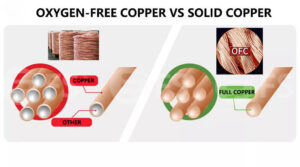
4. Simple On-Site Methods to Identify Copper Quality
Even without laboratory equipment, buyers can perform basic checks:
- Cross-section inspection
Bright, clean, and uniform copper indicates higher purity.
Dark or uneven color often signals recycled material. - Bending test
High-quality OFC remains flexible after repeated bending.
Low-grade copper cracks or breaks easily. - Documentation request
Professional factories can provide material inspection reports in English for reference.
5. Why Project Buyers Should Focus on Total Cost, Not Unit Price
Lower unit prices often lead to:
- higher failure and complaint rates
- increased maintenance costs
- brand or project reputation risk
Quality OFC cables:
- last 2–3 times longer
- reduce on-site troubleshooting
- protect long-term system stability
For engineering projects and wholesale brands, stability is more valuable than explanations.
6. Your Next Step: From Insight to Action
A true partner does more than supply products — they equip you with the knowledge and verification tools to de-risk procurement.
Ready to evaluate your cable supplier against these controls?
Contact us to request a Factory Quality Audit Overview or OFC sample cables with full test documentation, suitable for project review and internal approval.
Final Note for Wholesalers & Contractors
A reliable network cable supplier does more than manufacture cables —
they help buyers control risk, reduce after-sales issues, and deliver stable long-term performance.
When selecting cables for bulk distribution or projects, understanding conductor grades and factory controls is no longer optional — it is part of professional procurement.
Keywords: bulk Cat6 OFC cable, oxygen-free copper ethernet, 23 AWG solid copper conductor, TIA-568.2-D, CE CPR Eca, UL 444, wholesale China factory.
Pingback: Ethernet Patch Cables in 2026: Market Trends, Buying Guide & OEM Solutions