
As an Ethernet cable manufacturer, we are frequently asked by distributors and system integrators which type of Ethernet cable should be recommended for different projects.
From a factory and engineering perspective, the correct choice depends on the installation environment—not on whether a cable is shielded or unshielded. In most real-world applications, high-quality UTP Ethernet cables fully meet performance requirements while reducing cost and installation risk.
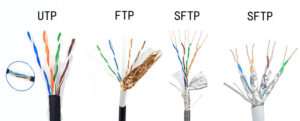
UTP vs FTP vs S(F)TP Ethernet Cables
| Item | UTP (Unshielded) | FTP (Foiled) | S(F)TP (Fully Shielded) |
|---|---|---|---|
| Shielding Structure | None | Overall aluminum foil | Individual pair shield + overall shield |
| EMI Protection Level | Standard | Medium | High |
| Installation Complexity | ★☆☆☆☆ (Easy) | ★★★☆☆ (Medium) | ★★★★★ (High) |
| Grounding Requirement | Not required | Required | Strictly required |
| Connector Requirement | Standard RJ45 | Shielded RJ45 recommended | Shielded RJ45 mandatory |
| System Cost | Lowest | Medium | Highest |
| Risk of Installation Errors | Very Low | Medium | High |
| Typical Cable Types | CAT5e / CAT6 / CAT6A | CAT5e / CAT6 / CAT6A | CAT6 / CAT6A |
| Best Use Environment | Homes, offices, standard projects | Moderate EMI environments | High EMI / industrial environments |
| Factory Recommendation | Default choice (≈90% projects) | Conditional choice | Project-specific only |
How to Choose the Right Cable — From a Manufacturer’s Perspective
-
UTP Ethernet Cable
Our factory recommends UTP as the default solution for most residential and commercial installations. It offers stable performance, easy installation, and the lowest total system cost. -
FTP Ethernet Cable
FTP is recommended when moderate electromagnetic interference is present and additional noise protection is beneficial, provided that grounding and installation conditions are properly managed. -
STP Ethernet Cable
STP should only be selected for confirmed high-interference environments and requires strict grounding and professional installation. It is not recommended for general projects due to higher cost and system risk.
Our Factory Position on UTP vs STP
Based on production experience, laboratory testing, and feedback from global projects, our factory recommends UTP Ethernet cables as the default solution for most residential and commercial installations.
Shielded Ethernet cables (STP) should only be recommended when strong electromagnetic interference is clearly present and when proper grounding conditions can be guaranteed.
Factory Cable Recommendation Logic for Distributors
To help our partners make confident and consistent recommendations, we follow a simple selection logic:
Residential projects & standard offices
→ Recommend CAT6 / CAT6A UTP Ethernet cablesCommercial projects with normal electrical equipment
→ UTP remains the preferred solutionIndustrial environments with heavy machinery or high-voltage systems
→ Evaluate interference conditions before considering STPSpecial environments (data centers, medical facilities)
→ Project-level technical assessment is recommended
Why Shielded Cables Are Not a Default Recommendation
From a manufacturing perspective, shielded cabling systems introduce additional requirements, including proper grounding, matching connectors, and controlled installation conditions.
When these conditions are not fully met, shielding may provide little benefit while increasing installation complexity and after-sales risk. For this reason, our factory does not recommend STP as a default option for standard projects.
Benefits for Distributors Following Factory Guidance
By following our factory-recommended cable selection approach, distributors can benefit from:
Clear and defensible product recommendations
Reduced installation and grounding-related issues
Lower total system cost for end customers
Fewer technical disputes and after-sales claims
Higher customer trust and repeat business
Our Commitment as a Manufacturer
As a manufacturer, our responsibility goes beyond supplying cables. We aim to help our distribution partners deliver stable, compliant, and reliable network solutions.
Choosing the right cable—rather than the most complex one—is key to long-term system performance.
Pingback: Ethernet Patch Cables in 2026: Market Trends, Buying Guide & OEM Solutions