The Complete Ethernet Cable Guide for Distributors and Installers
(Insider Knowledge from a 20-Year Manufacturer)
Introduction: Why We Wrote This Guide
In 2023, a distributor in Southeast Asia ordered 500 boxes of CAT6 from us. Six months later, they re-ordered 800 more. The reason wasn’t just price—it was because their customers stopped complaining about network drops. That’s what consistent quality does.
At Jinye Cable, we’ve been manufacturing Ethernet cables for over 20 years. In that time, we’ve learned that the cable you choose at the beginning of a project determines whether you receive referrals—or service calls—five years later.
We are a professional Ethernet cable manufacturer based in China with two decades of production experience. Over the years, we have shipped millions of meters of Cat5e, Cat6, Cat7, and Cat8 cables to distributors, installers, and project contractors worldwide.
As a long-term network cable manufacturer, we have seen what works, what fails, and what separates a reliable Ethernet cable supplier from the rest.
This guide is not just a specification sheet. It is the practical knowledge we wish every distributor and installer had before choosing their next Ethernet cable supplier.
If you want to learn more about our factory background, you can visit our About Us page to see our manufacturing capabilities and certifications.
Who We Are: More Than Just a Cable Factory
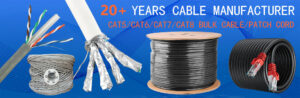
Jinye Cable isn’t a trading company with a website and a phone number. We’re a proper LAN cable manufacturer with our own production lines, our own quality control lab, and our own team of engineers who have been in this industry for two decades.
Located in Jiangxi, China, our factory runs 24/7 to supply distributors across Southeast Asia, Europe, the Middle East, and Africa. Every reel that leaves our facility has been tested, measured, and inspected—because our name goes on it, and our reputation travels with it.
When you work with Jinye Cable, you get:
✓ Production capacity that scales with you – Need 50 boxes for a trial order? No problem. Need 5,000 boxes for a national infrastructure project? We’ve got you covered. As a professional Ethernet cable manufacturer, we plan production around our partners’ needs.
✓ Quality control you can verify – Fluke test reports available upon request. Not every network cable manufacturer offers that.
✓ Your brand, your packaging – OEM/ODM is standard here, not an exception. We’re not just a CAT6 cable manufacturer—we’re your private label partner.
✓ Factory-direct pricing – No middlemen, no markups, no surprises. When you work directly with an Ethernet cable supplier like us, your margins stay where they belong.
✓ Global export experience – Our cables are widely used in Southeast Asia, Europe, the Middle East, and Africa.
For distributors seeking a reliable partner, working directly with an experienced LAN cable manufacturer isn’t just convenient—it’s the difference between competing on price and competing on value.
1 What Is an Ethernet Cable?
An Ethernet cable is a type of network cable used to connect devices in a Local Area Network (LAN) and transmit data between computers, routers, switches, IP cameras, and other networking equipment.
Inside each Ethernet cable are four twisted pairs of conductors. These twisted pairs are engineered to cancel electromagnetic interference and maintain stable signal transmission.
At Jinye Cable, we have been manufacturing Ethernet cables long before Wi-Fi became widely adopted. Over time, we have seen how some manufacturers reduce costs by lowering conductor thickness or using poor-quality materials.
As a responsible Ethernet cable manufacturer, we maintain strict control over conductor material, pair twisting precision, and cable jacket quality to ensure long-term reliability.
2 Common Types of Ethernet Cable We Manufacture
CAT5e Cable
CAT5e remains one of the most widely used Ethernet cables worldwide.
Specifications:
-
Bandwidth: 100 MHz
-
Speed: 1 Gbps
-
Maximum length: 100 meters
Typical applications include:
-
Home networks
-
Small business networks
-
CCTV camera systems
CAT5e cables are popular because they provide reliable Gigabit performance at a lower cost.
Our advice: For cost-sensitive markets or basic installations, CAT5e is still a solid choice. We produce it in both pure copper and CCA options, and we’re transparent about the difference.
For distributors who want to understand when to recommend different cable categories, we explain this in detail in our guide: Which Ethernet Cable Do I Need? – Factory Guidance for Distributors
CAT6 Cable
CAT6 cables provide higher bandwidth and improved performance compared with CAT5e.
Specifications:
-
Bandwidth: 250 MHz
-
Speed: 1 Gbps at 100m
-
Supports 10Gbps up to approximately 55 meters
Typical applications:
-
Corporate office networks
-
Commercial buildings
-
Medium-scale data centers
Our advice: For most commercial projects in 2025, CAT6 is the smart choice. It handles today’s bandwidth demands comfortably, supports PoE without issues, and gives your customers room to grow. If you’re a distributor looking for a single SKU that covers 80% of your market, CAT6 is it. As a dedicated CAT6 cable manufacturer, we ensure every batch meets or exceeds industry standards.
If you want a deeper comparison of similar cable categories, you can read our article: Cat6 vs Cat6e vs Cat6A Ethernet Cable Comparison
CAT6A and Higher Categories
For high-performance networks, we also manufacture:
-
CAT6A
-
CAT7
-
CAT8
CAT6A specifications:
-
Bandwidth: 500 MHz
-
Speed: 10Gbps up to 100 meters
Typical applications:
-
Enterprise data centers
-
High-speed network backbones
-
Large infrastructure projects
As global data usage continues to increase, demand for higher-category Ethernet cables is steadily growing. As a full-range network cable manufacturer, we offer the complete spectrum—from basic to cutting-edge.
3 What Goes Into a High-Quality Ethernet Cable
Understanding cable construction helps distributors evaluate product quality. Here’s what we look for—and what you should look for.
Conductor Material
Two common conductor materials are used in Ethernet cables:
| Material | Advantages | Best For |
|---|---|---|
| Pure Copper | Lower resistance, better PoE performance, longer distance, higher reliability | Mission-critical installs, PoE applications, long-term projects |
| CCA (Copper Clad Aluminum) | Lower cost | Budget-sensitive projects, short runs, basic networking |
Our advice: Pure copper costs more, but it saves callbacks. CCA has its place, but be honest with your customers about the tradeoffs. A trustworthy Ethernet cable supplier tells you both sides.
Twisted Pair Structure
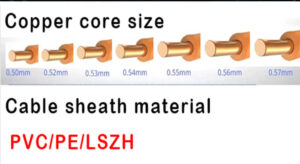
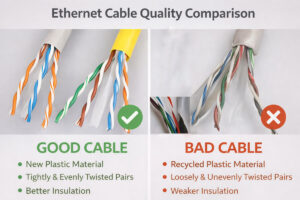
Each Ethernet cable contains four twisted pairs. The twist rate of each pair is carefully engineered to minimize signal interference and crosstalk.
Low-quality cables often have loose or inconsistent twisting, which significantly reduces transmission stability. At Jinye Cable, our production lines maintain tight tolerances because we take our role as a LAN cable manufacturer seriously.
Cable Jacket Materials
Different installation environments require different jacket types:
-
PVC: Standard indoor environments such as offices and homes.
-
LSZH (Low Smoke Zero Halogen): Used in public buildings such as airports, hospitals, and schools—anywhere toxic smoke matters in a fire.
-
PE Jacket (Polyethylene): Used for outdoor cables with UV and weather resistance. Don’t bury PVC outdoors and wonder why it fails in eighteen months.
4 Shielded vs Unshielded Ethernet Cable
UTP Cable (Unshielded Twisted Pair)
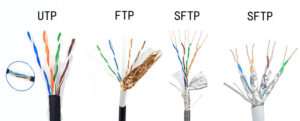
Unshielded twisted pair cables are the most common type used in structured cabling systems.
Advantages:
-
Lower cost
-
Easier installation
-
Flexible cable structure
Most residential and commercial installations work perfectly with high-quality UTP cables. In fact, if you’re not dealing with heavy electromagnetic interference, UTP is probably all you need.
Our factory explains this in more detail in our article: Should I Use Shielded Ethernet Cables at Home? 2025 Guide
Shielded Cable (FTP / SFTP)
Shielded cables include foil or braided shielding layers that protect signals from electromagnetic interference.
Best for:
-
Industrial facilities
-
Factories with heavy electrical equipment
-
High-interference environments
-
Runs parallel to power lines
Our advice: Shielded cables require proper grounding and professional installation. We’ve seen too many projects waste money on shielded cable installed like UTP. If you don’t terminate the shield correctly, you’ve paid extra for performance you’re not getting.
As an experienced Ethernet cable manufacturer, we’re honest about this: buy shielded only when you actually need it.
5 Ethernet Cable Pricing: What Distributors Should Expect in 2025
“What’s your price for a 305m box?” We get this question daily. And the honest answer? It depends.
For standard CAT5e or CAT6, our wholesale range is typically $15 to $25 per box. But here’s what actually determines the final price:
| Factor | Impact on Price | Our Advice |
|---|---|---|
| Conductor diameter (23/24/26AWG) | Thicker = higher cost | 24AWG is the sweet spot for most projects |
| Material: Pure copper vs CCA | Copper costs more | Pure copper for PoE and long-term reliability |
| Shielding | Adds 10-20% to cost | Only buy if you need it |
| Packaging: Standard vs pull box | Pull boxes cost slightly more | Worth it for installer convenience |
| Order quantity | Volume discounts apply | Plan ahead to maximize savings |
One more thing: Copper prices fluctuate globally. Any quote more than 30 days old is just a guess. Contact us directly as your Ethernet cable manufacturer for current pricing based on LME copper rates.
For large projects, we recommend confirming prices and reserving production slots in advance—especially during peak seasons.
6 How to Choose a Reliable Ethernet Cable Manufacturer
When selecting a network cable manufacturer, here’s what we recommend you look for:
Production capacity – Can they ship 500 boxes next month? Ask for their monthly output. A serious CAT6 cable manufacturer should have clear answers.
Quality control – Do they provide Fluke test reports? If they say “trust us,” walk away. A professional Ethernet cable supplier documents their quality.
Certifications – CE, RoHS, UL? If they’re exporting internationally, these should be standard.
OEM capability – Can they print your logo and use your packaging? Most serious manufacturers can.
🚩 5 Red Flags to Watch Out For:
-
They can’t or won’t show you their factory. Video call or it didn’t happen.
-
Prices that seem too good to be true. They usually are—check the conductor material.
-
No test reports available. If they’re not testing, someone else will be testing their failures.
-
Vague answers about lead times. “It depends” without follow-up is a bad sign.
-
They’re a trading company pretending to be a factory. Ask for photos of the production floor.
Working directly with a professional LAN cable manufacturer helps distributors ensure stable quality and competitive pricing. If a manufacturer ticks all the boxes above—and none of the red flags—you’ve found a partner worth keeping.
For buyers sourcing bulk cables, our OEM and wholesale services are explained here: Bulk Ethernet Cable Supplier & OEM Partner
7 Real-World Success: How We Help Distributors Win
Case Study 1: Southeast Asia Distributor
A distributor in Vietnam approached us in 2022. They had been buying from three different suppliers and struggling with inconsistent quality—one batch would be fine, the next would have customers complaining.
We started with a trial order of 100 boxes of CAT6. They tested every reel. Six months later, they placed their first container order. Today, Jinye Cable is their exclusive Ethernet cable supplier.
“The difference isn’t just the cable quality,” their owner told us. “It’s knowing that every box will be the same. No surprises.”
Case Study 2: Middle East Project Contractor
A contractor in Dubai was sourcing cable for a hotel project—2,000 rooms, all needing network and CCTV. They needed consistent supply over six months, with strict quality requirements.
We scheduled production in phases, provided Fluke test reports for every batch, and delivered on time despite global shipping delays. The hotel opened on schedule, and we’re now working on their next project.
Case Study 3: European Private Label Client
A European distributor wanted to launch their own brand of Ethernet cables. They needed OEM service—custom printing, custom boxes, and consistent quality to build their reputation.
We handled everything. Today, their brand is on thousands of boxes across Germany and France, and they’ve never had a quality complaint. That’s what happens when you partner with a network cable manufacturer who treats your brand like their own.
These aren’t exceptions. This is how we work with every partner.
8 Why Global Demand for Ethernet Cables Keeps Growing
Global demand for Ethernet cables continues to increase due to several technology trends:
-
Cloud computing
-
Smart cities
-
IoT infrastructure
-
Surveillance systems
-
Enterprise digitalization
-
5G backhaul (small cells need connections)
For distributors, this means one thing: Ethernet cable is a steady, repeat-purchase product. Once you find a reliable LAN cable manufacturer, customers come back year after year.
9 Common Misconceptions About Ethernet Cables
After 20 years in this industry, here are the myths we hear most often—and the truth behind them:
Myth 1: All Ethernet cables are the same
Truth: Conductor material, jacket quality, and twist rates vary dramatically. The cheapest cable can cost half as much as a quality cable—and fail twice as fast.
Myth 2: CCA is just as good as pure copper
Truth: CCA has higher resistance, generates more heat with PoE, and is more brittle. It has its place in budget projects, but it’s not equivalent.
Myth 3: Higher category always means better
Truth: CAT8 won’t make your home network faster if your router only supports Gigabit. Match the cable to the application.
Myth 4: Shielded cable is always better
Truth: Shielded cable requires proper grounding. Install it wrong, and you’ve wasted money on performance you’re not getting.
Myth 5: All Chinese manufacturers are the same
Truth: There are trading companies and there are factories. There are manufacturers who cut corners and manufacturers who test every batch. Know the difference. A genuine Ethernet cable manufacturer invites scrutiny.
Myth 6: Price is the only thing that matters
Truth: The cheapest cable often costs more in the long run—through callbacks, replacements, and damaged reputation.
Myth 7: 100 meters is a suggestion
Truth: 100 meters is a limit. Beyond that, signal degrades. Plan accordingly.
Myth 8: PoE doesn’t affect cable choice
Truth: PoE generates heat. Thin conductors and CCA materials handle heat poorly. Choose wisely.
Myth 9: Outdoor cable is overkill for protected runs
Truth: UV exposure and moisture find a way. Use outdoor-rated cable outside.
Myth 10: A good installer can make any cable work
Truth: No amount of skill fixes bad materials. Start with quality cable from a trusted Ethernet cable supplier.
10 Frequently Asked Questions About Ethernet Cables
What is the difference between CAT5e and CAT6?
CAT6 cables support higher bandwidth (250 MHz) compared with CAT5e (100 MHz), providing better performance in high-speed networks. As a CAT6 cable manufacturer, we can tell you that most of our customers upgrading to CAT6 notice immediate improvements in network stability.
How long can an Ethernet cable run?
The standard maximum length for Ethernet cable is 100 meters (328 feet). Beyond that, you’re gambling. If you need longer, put a switch in the middle.
Can CAT6 support PoE?
Yes. CAT6 cables are widely used for Power over Ethernet applications such as IP cameras and wireless access points. In fact, for high-power PoE applications, we recommend pure copper CAT6 or higher—better heat handling, less voltage drop.
Why are some Ethernet cables cheaper than others?
Price differences may be caused by:
-
Conductor material (CCA vs pure copper)
-
Conductor thickness (26AWG vs 24AWG)
-
Shielding design
-
Certification requirements
-
Quality control standards
How do I choose the right Ethernet cable manufacturer?
Choosing the right Ethernet cable manufacturer depends on several factors:
• Production capacity and delivery time
• Quality control procedures and testing reports
• Certifications such as CE, RoHS, or UL
• OEM and private label capabilities
• Experience exporting to international markets
Working with an experienced network cable manufacturer ensures stable supply, consistent quality, and long-term partnership reliability.
Are you really a factory, not a trading company?
Yes. We own our production facility in Jiangxi, China. We are a direct LAN cable manufacturer, not a middleman. You’re welcome to visit our factory.
Can you put my logo on the cable?
Yes. We offer OEM printing on the jacket and custom packaging. Contact us for MOQ details.
For more technical questions from distributors and buyers, you can also explore our full FAQ page: 30 Questions About Ethernet Cable Supplier
Final Thoughts: Let’s Build Something That Lasts
Ethernet cables aren’t the most exciting part of a network. But ask any IT manager what keeps them up at night, and they won’t mention the router or the switch. They’ll mention the intermittent connection they can’t trace, the PoE camera that keeps dropping, the user complaining about slow speeds for the third time this month.
Those problems often start with the cable.
At Jinye Cable, we’ve spent 20 years making sure our partners don’t have those conversations. From raw material selection to final testing, we focus on one thing: reliable performance that outlasts the warranty.
If you’re a distributor looking for:
✓ A stable, experienced Ethernet cable manufacturer
✓ Consistent quality you can stake your reputation on
✓ Competitive pricing without the games
✓ A partner who answers the phone when you need them
…we should talk.
Whether you need a trial order of 50 boxes or a container load for a national project, we’re ready to support you. When you choose Jinye Cable, you’re choosing more than just a supplier. You’re choosing a network cable manufacturer with two decades of experience, a CAT6 cable manufacturer who tests every batch, and an Ethernet cable supplier who treats your business like their own.
Contact Jinye Cable today for samples, current pricing, or to discuss OEM cooperation. Let’s build something that lasts—together.